Home / Robotic Joint Replacement
Robotic-Assisted Knee & Joint Replacement in Ahmedabad
Understand how robotic technology supports joint replacement surgery, where it may help, and why the right treatment still depends on an individual orthopaedic assessment.
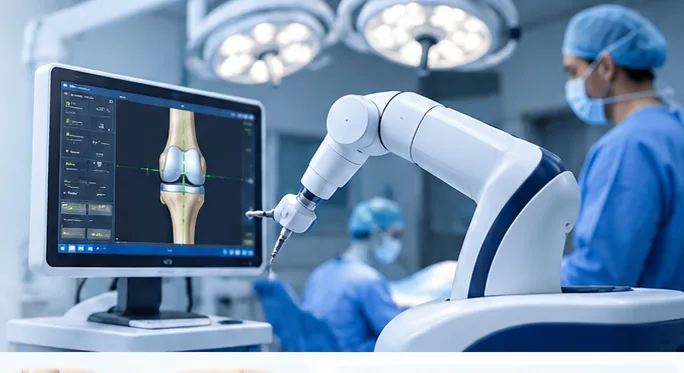
Dr. Manish Diwakar, Senior Orthopaedic Surgeon and Head & Director of Vedant Multispeciality Hospital, Gota, Ahmedabad, provides evaluation and treatment planning for patients with knee and hip problems. This guide explains robotic-assisted joint replacement in balanced, patient-friendly terms.
What is robotic-assisted joint replacement?
Robotic-assisted joint replacement combines a surgeon’s expertise with digital planning and instrument guidance. Depending on the system, information from scans or sensors can help the surgeon plan bone preparation and implant placement. The robot does not replace the surgeon; the surgeon remains responsible for the operation.
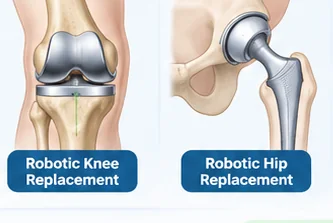
Potential advantages and important limitations
Potential advantages
- More detailed preoperative or intraoperative planning
- Assistance with implant positioning and alignment
- Ability to assess certain aspects of joint balance during surgery
- Personalised planning for some complex anatomy or deformities
Limitations and disadvantages
- Not all patients need or benefit from robotic assistance
- Long-term superiority over well-performed conventional replacement is not established for every outcome
- May involve additional cost, equipment or imaging requirements
- Some systems require fixation pins or extra setup time
- It does not eliminate surgical risks or rehabilitation
Who should consider knee replacement?
Knee replacement may be considered when advanced osteoarthritis causes ongoing pain, stiffness, deformity or difficulty with walking and daily activities despite appropriate non-surgical treatment. Your surgeon will assess symptoms, X-rays, ligament function, general health and goals before discussing partial or total knee replacement, with or without robotic assistance.
Robotic versus conventional knee replacement
Both approaches aim to relieve pain and restore useful function by replacing damaged joint surfaces. Robotic systems may help with certain technical measurements, but successful recovery also depends on patient selection, surgical judgement, implant choice, rehabilitation and management of medical conditions. Conventional surgery remains a well-established option.
How robotic-assisted joint replacement is planned
Assessment
Symptoms, examination and appropriate imaging.
Planning
Implant size, alignment and positioning are considered.
Surgeon-guided procedure
The surgeon uses available technology to assist preparation and placement.
Rehabilitation
Individualised mobilisation, exercises and follow-up.
What happens before and after surgery?
Before surgery
Your team reviews symptoms, examines the joint, assesses X-rays and other tests where indicated, and discusses treatment choices, medical fitness, anaesthesia and realistic expectations.
After surgery
Pain control, early supported mobilisation when safe, wound care, clot-prevention measures and structured physiotherapy are important. The exact walking schedule and precautions depend on the operation and your clinical condition.
Risks to discuss
All joint replacement procedures involve risks, including infection, blood clots, stiffness, ongoing pain, fracture, nerve or blood vessel injury, implant wear or loosening, and possible further surgery. A consultation is the right place to discuss individual risks and expected benefits.
Frequently asked questions
Is robotic knee replacement better than conventional knee replacement?
Robotic assistance can improve the precision of surgical planning and some aspects of implant positioning. However, it has not been shown to guarantee better long-term outcomes for every patient. Your anatomy, arthritis severity, surgical technique, rehabilitation and overall health all matter.
Does the robot perform the surgery by itself?
No. The orthopaedic surgeon controls the procedure and makes the clinical decisions. The robotic system provides planning, guidance or controlled assistance, depending on the technology used.
Who may be suitable for robotic-assisted knee replacement?
People with advanced knee arthritis who are already candidates for knee replacement may be considered. Suitability depends on symptoms, examination, imaging, bone quality, deformity and other health conditions.
Can robotic technology be used for partial knee replacement?
Some robotic systems support partial knee replacement as well as total knee replacement. The type of procedure depends on the distribution of arthritis, ligament function and the technology available.
How long does recovery take after robotic knee replacement?
Recovery varies. Walking with assistance often begins early after surgery when medically appropriate, while improvement in strength, movement and confidence generally continues over weeks to months. Robotic assistance does not remove the need for rehabilitation.
What are the risks of robotic knee replacement?
It carries the usual risks of knee replacement, including infection, blood clots, stiffness, persistent pain, nerve or blood vessel injury, and implant-related complications. Some systems also have technology-specific considerations, such as additional imaging or fixation-pin sites.
Is robotic knee replacement available in Gota, Ahmedabad?
For current robotic-assisted joint replacement options, technology availability, surgeon assessment and appointment details, please contact Dr. Manish Diwakar’s team at Vedant Multispeciality Hospital in Gota, Ahmedabad.
Discuss the right treatment for your knee or hip
For assessment and current information about robotic-assisted surgery options, contact the team at Vedant Multispeciality Hospital, Gota, Ahmedabad.
Request an appointmentYou can also read our joint replacement overview and orthopaedic FAQs.
This page provides general educational information, not a personalised diagnosis or a promise that any specific robotic platform is available. Please confirm current services with the hospital.


